 Eduardo de Souza
Free to Play Fantasy Games Library
Product Design Manager · 2 Designers, 1 PM, 4 Engineers · 6 Months · 2024
Context
Retention is the hardest problem in iGaming. Operators spend heavily to acquire players, then watch engagement drop off between major sporting events. Free-to-play games — low-stakes, socially shareable, no deposit required — had proven effective at keeping casual audiences engaged. But WA Technology had no native offering. Operators were cobbling together third-party tools that didn't match their brand and couldn't be customised at scale.
Opportunity
The brief was to build a library of white-label free-to-play formats that any operator could deploy rapidly — fully themeable through the Belloa design system, compatible with existing sportsbook and casino infrastructure, and genuinely fun to play. Player Reveals and Predict 6 were the two formats chosen to lead the library.
Player Reveals
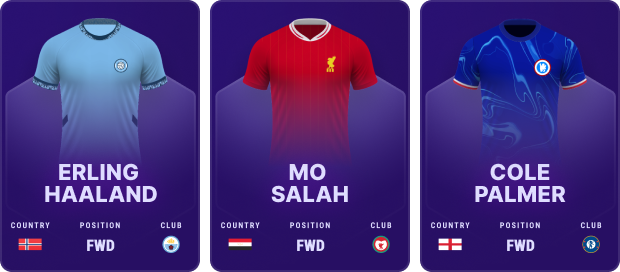
Player Reveals is a card-flip prediction game. Before a match, players are shown a set of athlete cards face-down and must predict whether a player will hit a stat threshold — goals, assists, points — before the card flips to reveal the outcome. The format borrows the dopamine loop of collectible card mechanics: the reveal moment is the hook.
The challenge was designing a reveal that felt earned. We went through multiple motion explorations — peel, flip, shatter — before settling on a clean 3D card flip that communicated finality without over-engineering the transition. The stat display beneath the reveal needed to be immediately legible under the emotional weight of the moment.
Design Direction
Both games needed to feel like products in their own right — not features bolted onto a sportsbook. We established a visual language built around athlete photography, strong typographic hierarchy, and sport-coded colour. The dark surface system from Pick'em carried over, keeping the Belloa token architecture intact while letting each operator apply their own brand on top.
AI Feedback Loop
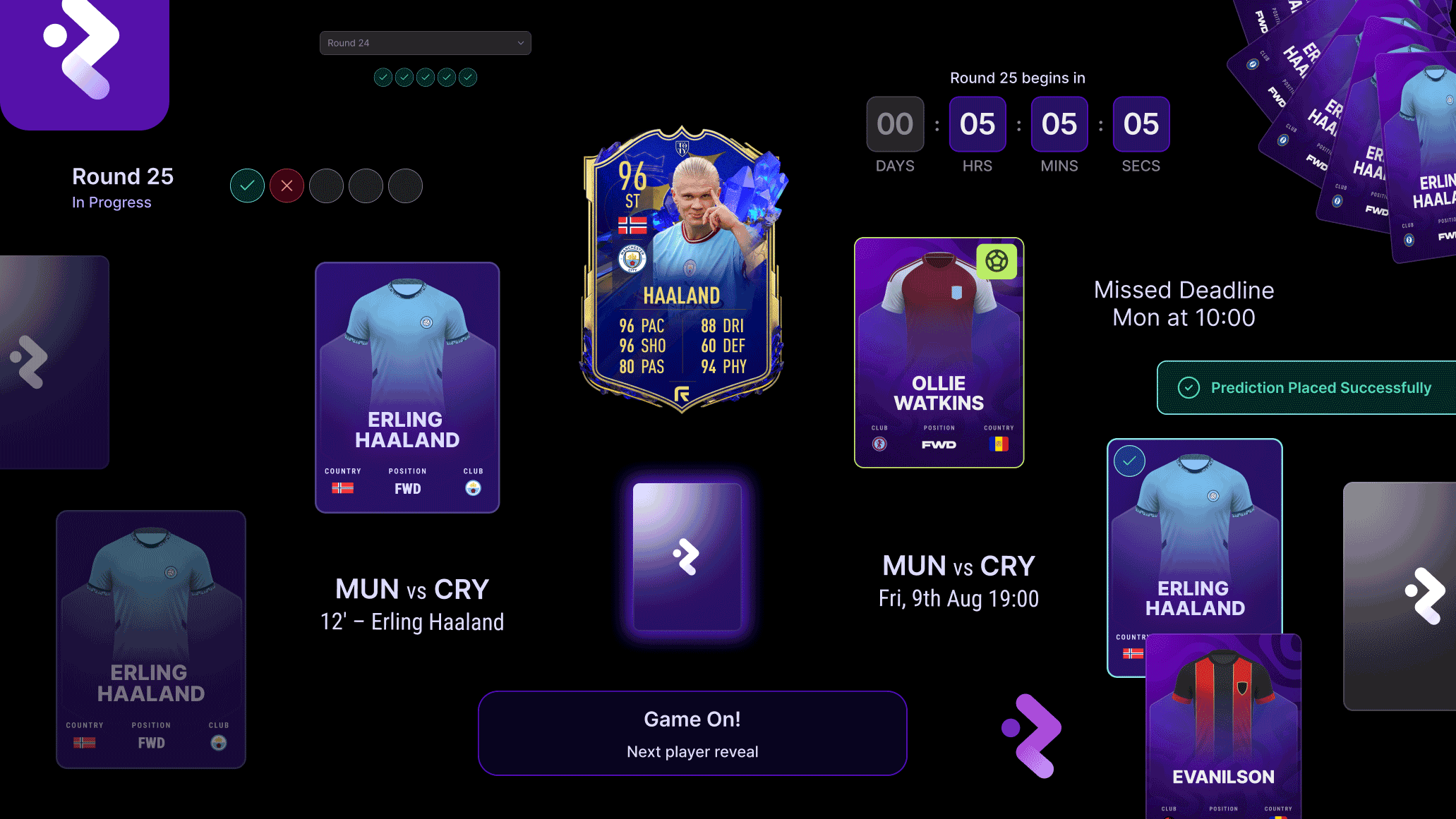
One of the more experimental parts of this project was integrating an AI-assisted feedback loop into the design process. We used generative tools to rapidly prototype visual variations of the card states and reveal animations — compressing what would have been multi-day explorations into hours.
The output wasn't production-ready, but it accelerated alignment with stakeholders by making concepts tangible earlier. It shifted conversations from abstract direction to concrete tradeoffs — which is where the real design decisions happen.
Predict 6 and the Unified Library
Predict 6 is a pre-match prediction game: players pick the outcomes of six events from an upcoming fixture list and submit their entry before kick-off. It's a format with a long pedigree in football — familiar enough that acquisition cost is low, structured enough to drive weekly repeat engagement. Our version was built as a modular template: the fixture feed, the entry form, the results screen, and the leaderboard all exist as independent components that operators can mix and configure.
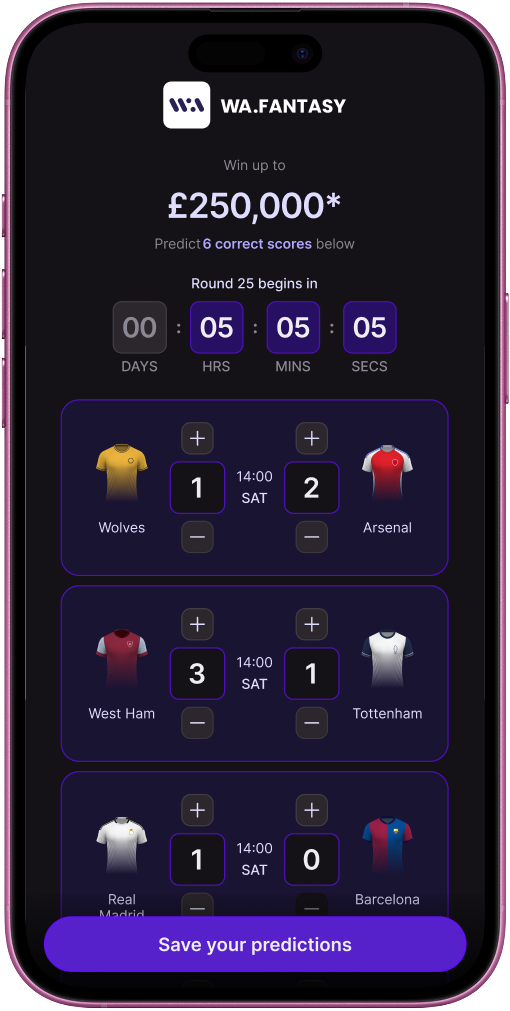
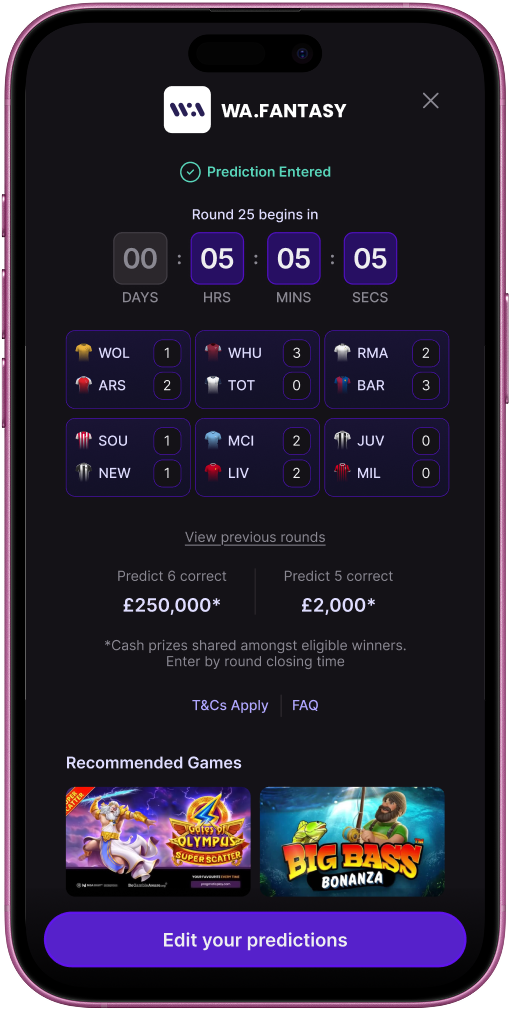
Designing both games in parallel revealed natural opportunities for shared infrastructure. Entry confirmation patterns, result state displays, and the leaderboard UI were abstracted into reusable components that now sit in the Belloa library — available to any future free-to-play format we build.
Securing Buy-In
Free-to-play doesn't generate direct revenue — which made internal buy-in harder to secure than for a conversion-focused product. The business case rested on retention and cross-sell data: operators who kept players engaged between live events saw measurably higher lifetime value.
Framing the library as infrastructure rather than a feature was the move that landed it. These weren't two games — they were the foundation of a scalable retention toolkit. That reframe shifted the conversation from "is this worth building?" to "how quickly can we get this to operators?"
Outcome
— Two free-to-play game formats shipped: Player Reveals and Predict 6.
— Reusable component set added to Belloa — shared entry, result, and leaderboard patterns available across all future formats.
— Deployed across multiple operator brands with zero bespoke engineering work per client.
— Established the foundation for an ongoing free-to-play library — a scalable retention toolkit rather than a one-off feature.
The free-to-play library proved that retention products don't need to be complex to be effective — they need to be fast, familiar, and fun. By building on the Belloa foundation, we delivered two polished game formats without reinventing the design system. The infrastructure scales. The games don't need to.
Get in touch →